
Fitting out windows in a new home? Replacing old ones? Or just upgrading them for a better outlook? Aluminium windows should be your go-to choice. In this blog, we will discuss why Aluminium windows have dominated Singapore’s residential market and why you should pick them as well.
Here, you will find window types, material comparisons, HDB and BCA compliance, real price ranges, design options, and how to find a reliable aluminium window contractor in Singapore. Read on before you make a purchase.
What Are Aluminium Windows?
Aluminium windows are window systems where the frame is made from aluminium alloy profiles. Unlike timber or steel, aluminium is lightweight, naturally corrosion-resistant, and highly versatile, making it a popular material across Singapore’s HDB, BTO, condo, and landed property markets.
Another interesting thing about Aluminium is that it does not rust. It forms a thin, self-protective oxide layer when exposed to air, which prevents further oxidation. This inherent property makes it ideal for Singapore’s high-humidity tropical climate, where steel would corrode, and timber would swell, warp, or rot.
Beyond corrosion resistance, aluminium can be extruded into precise, thin-walled profiles, which means slimmer frames, larger glass areas, and more natural light compared to equivalent timber or steel frames.
Why Aluminium Is the Most Common Window Material in Singapore
Aluminium’s dominance in Singapore’s window market comes down to a combination of performance, practicality, and economics:
- Aluminium’s natural oxide layer makes it corrosion and rust-free without any coating, unlike steel or mild steel.
- Aluminium is roughly one-third the weight of steel, making it easier to handle, fabricate, and install.
- It is also low maintenance, which means no repainting, no rust treatment, and no seasonal sealing.
- Aluminium windows are also very versatile when it comes to design; they can be powder-coated in virtually any colour (including matte black, white, silver, bronze, and champagne), anodised for a metallic sheen, or finished in wood-grain foil.
- Aluminium is also the approved material for HDB window replacement. All major suppliers in Singapore manufacture to HDB-compliant specifications.
- If maintained properly, quality aluminium windows last 15 – 25 years in Singapore’s climate, making them a cost-effective long-term investment.
What Are the Types of Aluminium Windows?
Choosing the right window type for each room is as important as choosing the right material. That’s why we always recommend our customers understand window types before they make a decision. Here’s how the main types compare:
| Window Type | How It Opens | Key Benefit | Best For |
| Casement | Hinged side; opens outward | Max ventilation; wide openings | Living rooms, bedrooms |
| Sliding | Panels slide horizontally | Space-saving; easy operation | Kitchens, smaller rooms |
| Top-Hung | Hinged at top; opens outward at bottom | Rain-safe ventilation | Bathrooms, toilets |
| Awning | Hinged at top; opens outward | Ventilation even during rain | Service yards, bathrooms |
| Fixed (Picture) | Does not open | Maximum light; structural security | High-rise, corridor views |
| Louvre | Adjustable horizontal slats | Precise airflow control | Not recommended for new HDB (safety restrictions) |
Casement Aluminium Windows
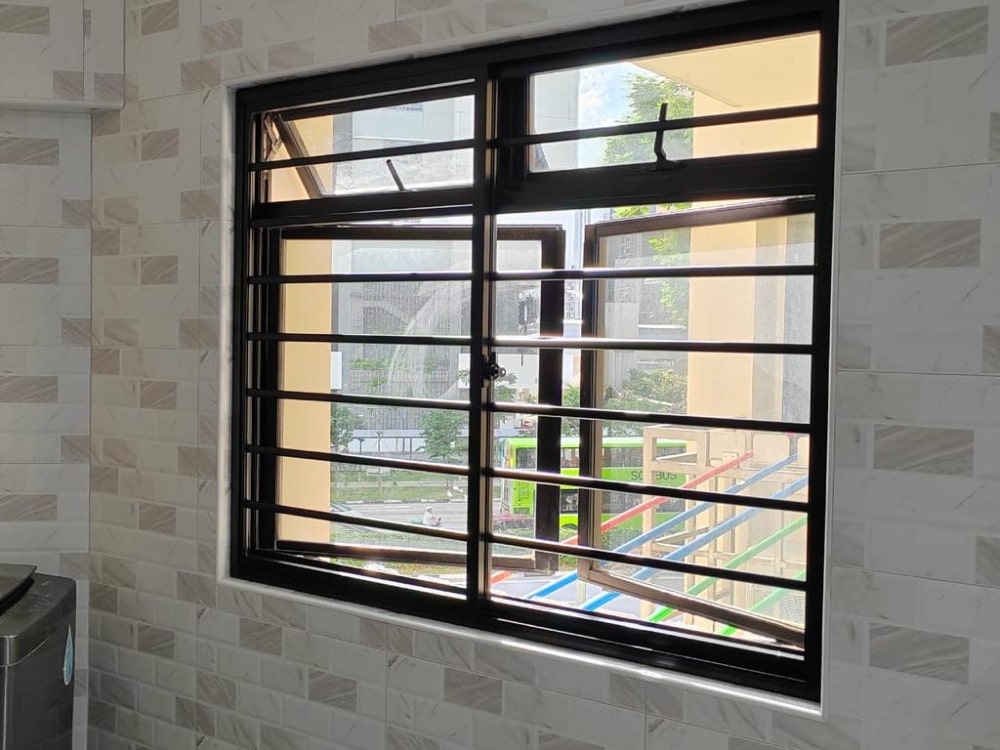
Casement windows are the most popular choice for Singapore HDB living rooms and bedrooms, offering maximum ventilation and a clean, modern look. AT Aluminium offers casement windows in silver, white, and black frames with clear, tinted, or blue glass options.
Sliding Aluminium Windows
Sliding windows are the second most popular type for Singapore HDB flats. Their horizontal sliding mechanism saves space
Aluminium Windows with Invisible Grilles
Invisible grilles (also called stainless steel cable grilles) are increasingly popular for Singapore homeowners who want child safety without compromising views or natural light.
How to Choose the Right Window Type for Each Room?
When choosing the window type for your home, you need to think of what you need the most in that room. For example, we often tell our clients that living rooms are where most gatherings happen, so they should go for casement windows for maximum ventilation.
For rooms where space is an issue, sliding or casement windows are the best option. Similarly, for spaces like toilets and kitchens, we often recommend sliding or awning windows with a top-hung design.
Aluminium vs UPVC Windows: Cost, Durability & Insulation
UPVC (Unplasticised Polyvinyl Chloride) windows are common in Europe and growing in Singapore. For Singapore’s climate, aluminium remains the more practical and proven choice. UPVC’s thermal insulation advantage is less critical in a hot climate where we rarely heat spaces, and its tendency to discolour under intense UV exposure is a real concern at our latitude.
Aluminium vs Timber Windows: Performance in Singapore’s Climate
Timber windows are rarely used in Singapore today for good reason. Wood-grain powder coat finishes on aluminium frames give you the warm, natural aesthetic of timber with none of the maintenance burden, a popular choice for landed property owners who want a traditional look.
Aluminium vs Steel Windows: Strength, Weight & Price
Steel windows are occasionally used for industrial loft-style aesthetics, but for standard residential use in Singapore, aluminium is the practical choice in every category.
How Aluminium Windows Perform in Singapore’s Tropical Climate
Singapore’s climate presents specific challenges for windows: intense UV radiation year-round, daily rainfall, humidity averaging 80 – 85%, and the occasional typhoon-strength winds during the monsoon season. Let’s discuss why aluminium windows are a smart choice for Singapore’s tropical climate:
- Powder-coated aluminium frames resist UV-induced fading and chalking for 15+ years. Anodised finishes offer even higher UV resistance.
- Quality aluminium window systems include rubber seals and weep holes that channel rainwater out of the frame.
- Singapore’s BCA standards require residential windows to meet specific wind load ratings.
- Aluminium does not absorb moisture or expand in humidity, unlike timber. This makes the material ideal for Singaporean weather.
- Standard aluminium profiles conduct heat, which can contribute to solar heat gain. Thermal-break aluminium profiles (with a non-conductive strip between inner and outer frame sections) significantly reduce this. Double-glazed units offer the best combined thermal and acoustic performance.
HDB Requirements for Aluminium Windows in Singapore

HDB imposes specific requirements for window replacement in Singapore’s public housing. Unlike gate replacements, window replacement in HDB flats requires a renovation permit, and the installation must be carried out by a BCA-approved window contractor (AWC) listed in HDB’s Directory of Renovation Contractors. Let’s discuss a few requirements that you need to be mindful of:
- Your contractor must apply to HDB for a renovation permit before commencing any window replacement work.
- Window works must be carried out by a BCA-approved window contractor — DIY or unlicensed installation is not permitted. Under the Building Control Regulations, failing to retrofit casement windows with stainless steel rivets carries a fine of up to S$5,000 and/or 6 months’ jail, and if a window falls due to lack of maintenance, the penalty rises to up to S$20,000 and/or 12 months’ jail.
- Windows on the lowest level are exempt from BCA’s Building Control Regulations, as there’s no danger of objects falling from height.
- Replacement of full-height windows (including ¾-height and bay windows) is generally not allowed unless the frame is damaged and requires complete replacement.
- Sliding panel width limit: For aluminium sliding windows, the sliding panel width must not exceed 1.2 metres.
- Only zinc-casting corner brackets are approved for the corners of window leaves.
- All aluminium rivets in casement windows must be replaced with stainless steel Grade 304 rivets to prevent corrosion-induced detachment.
For the full, current HDB Window Works Regulations, refer to the official HDB Window Works Guidelines.
Standard Aluminium Window Sizes for HDB Flats
HDB flats have broadly standardised window opening sizes across flat types, though older resale flats and special flat types may vary:
| Flat Type | Typical Window Opening | Common Window Type |
| 3-Room HDB | 900-1200mm wide, 1200-1500mm tall | Casement or sliding, 2-3 panels |
| 4-Room HDB | 1200-1500mm wide, 1200-1500mm tall | Casement or sliding, 2-3 panels |
| 5-Room / Executive HDB | 1500-1800mm wide, 1500mm tall | Sliding (2-3 track) or casement |
| Service Yard | 600-900mm wide | Sliding or fixed |
| Toilet / Bathroom | 450-600mm wide | Top-hung or awning (small) |
Always measure your existing window openings carefully and share the measurements with your contractor before ordering.
Aluminium Window Prices in Singapore (2026 Cost Guide)

Aluminium window prices in Singapore vary significantly based on window type, glass specification, frame size, storey height, and whether grilles are included. Here is a realistic 2026 price guide:
| Window Type / Configuration | Approx. Price Per Window (Installed) |
| Standard sliding window (2-panel) | S$280 – S$500 |
| Standard casement window (2-panel) | S$400 – S$700 |
| Premium casement (black/dark frame) | S$600 – S$900 |
| Sliding window with grilles | S$450 – S$750 |
| Top-hung / awning window | S$300 – S$500 |
| Double-glazed window (any type) | Add S$200–S$500 per window |
| Full flat replacement (4-room HDB) | S$3,000 – S$8,000+ |
For a personalised quote based on your flat type and specifications, contact AT Aluminium or check our current promotions and packages.
The Aluminium Window Installation Process and Timeline
Here’s what to expect when you engage AT Aluminium for a window replacement:
- Step 1 – Free site measurement: Our team visits your unit to measure all window openings, assess existing frames, and discuss your design and glass preferences.
- Step 2 – Quotation: We provide a detailed, itemised quote covering materials, glass type, installation, permit application fees, and disposal of old windows.
- Step 3 – Permit application: As a BCA-licensed AWC, we apply for the HDB renovation permit on your behalf.
- Step 4 – Fabrication: Windows are fabricated to your exact specifications at our facility. Standard sizes: 3–7 working days. Custom sizes: 7–14 working days.
- Step 5 – Installation: Our certified installers remove existing windows, prepare the opening, fit and seal the new windows, and dispose of the old frames.
- Step 6 – Final check: We test all panels for smooth operation, check seals for watertightness, and verify grille (if any) alignment before handover.
Common Aluminium Window Problems and How to Prevent Them
Even quality aluminium windows can develop issues over time. Here’s what to watch for:
| Problem | Prevention / Fix |
| Water leakage around the frame | Inspect and replace rubber seals every 8–12 years; ensure proper flashing during installation |
| Sliding panel running off track | Keep tracks clean; replace rollers when sliding becomes difficult |
| Stiff casement hinge | Lubricate the friction with silicone spray every 6 months |
| Frame discolouration | Quality powder coat lasts 15+ years; cheap finishes fade in 5–7 years |
| Condensation on glass | Double glazing minimises condensation; ensure adequate ventilation |
| Rattling in the wind | Inspect and replace gaskets; tighten frame screws annually |
| The window won’t lock properly | Realign frame; replace handle/latch assembly |
HDB recommends residents to inspect their windows every 6 months. A simple “Check, Clean, and Change” routine each June and December. You should be checking for rust, loose components, and smooth operation; cleaning tracks; and changing worn parts.
Choosing the Right Aluminium Windows in Singapore
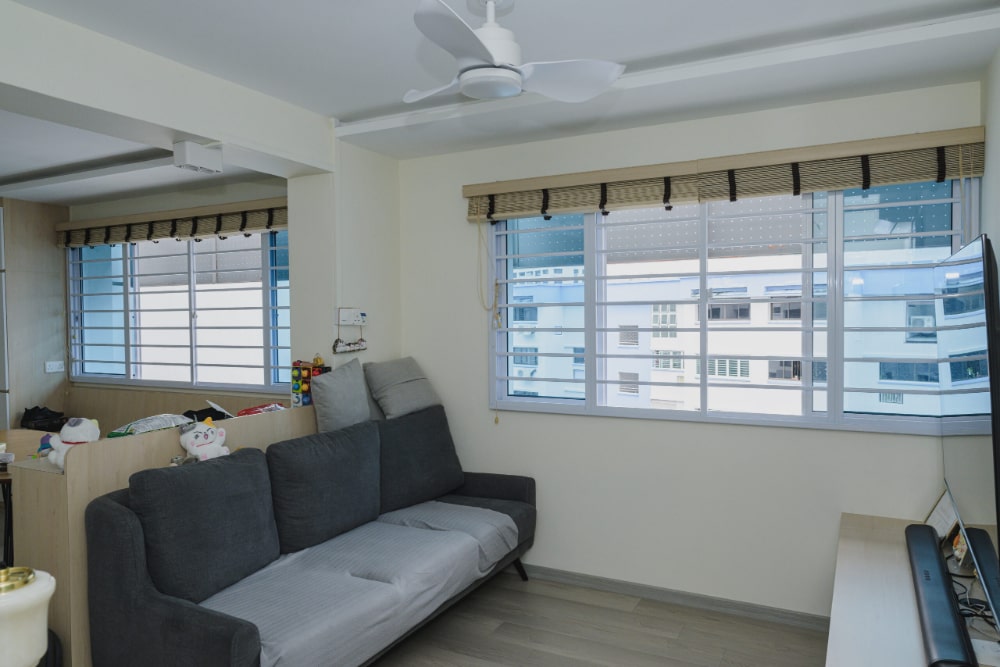
Aluminium has earned its place as Singapore’s default window material for good reason. But the material is only half the decision. Matching the right window type to each room is what makes a window genuinely work day to day.
As a certified AWC, AT Aluminium handles the entire process for you — from free site measurement and an itemised quote to the HDB permit application, fabrication, installation, and final watertightness check. Whether you’re replacing a single window or fitting out a whole flat, our team will recommend the right configuration for your layout and budget.
Ready to start? Book a free site measurement or view our current window packages and promotions for a personalised quote based on your flat type and specifications.
Frequently Asked Questions
What is the average price of aluminium windows in Singapore?
Aluminium window prices in Singapore start from around S$280 for a basic 2×4 panel sliding window and range to S$900+ per window for premium casement windows with dark frames and speciality glass. A full 4-room HDB flat replacement typically costs S$3,000–S$8,000+, depending on specifications.
How much does a window cost in Singapore in 2026?
In 2026, installed aluminium window prices range from S$280–S$500 for a standard sliding window, S$400–S$900 for casement windows, and S$450–S$750 for sliding windows with grilles. Double glazing adds approximately S$200–S$500 per window. These prices include materials, installation, and BCA permit application.
Are aluminium windows expensive compared to other materials?
Aluminium windows are mid-range in cost. They are generally less expensive than timber or UPVC when total lifecycle cost is considered, since aluminium requires virtually no maintenance over its 15–25 year lifespan. While upfront costs are comparable to UPVC, the lower maintenance burden makes aluminium significantly more cost-effective over time in Singapore’s climate.
Which is cheaper — steel or aluminium windows?
Aluminium windows are generally cheaper than steel windows of equivalent quality and performance. Steel frames require more material (due to their weight), cost more to fabricate, and require ongoing rust-prevention maintenance. Aluminium’s inherent corrosion resistance eliminates this maintenance cost entirely.
What’s the difference between casement and sliding aluminium windows?
Casement windows are hinged on one side and open outward — they provide maximum ventilation and suit living rooms and bedrooms. Sliding windows have panels that slide horizontally on tracks — they are space-saving and suit kitchens and smaller rooms.
Are aluminium windows good for Singapore’s tropical climate?
Yes, aluminium is among the best materials for Singapore’s climate. Its natural corrosion resistance handles year-round humidity (averaging 80–85%) without rusting. Quality powder-coated frames resist UV fading for 15+ years. Proper rubber sealing handles heavy monsoon rainfall, and aluminium’s dimensional stability ensures windows continue to open and close smoothly in all temperatures.
Do I need BCA approval to install aluminium windows in my HDB flat?
Yes. HDB window replacement requires a renovation permit, and the installation must be carried out by a BCA-approved window contractor (AWC) listed in HDB’s Directory of Renovation Contractors. AT Aluminium is a certified AWC and handles the permit application as part of our service. For full requirements, refer to the HDB Window Works Guidelines.
How long do aluminium windows last in Singapore?
Quality aluminium windows installed by a certified contractor typically last 15–25 years or more in Singapore. The main wear components are rubber seals (replace every 8–12 years), rollers and friction stays (10+ years), and handles/latches. The aluminium frame and glass panels themselves rarely need replacing if initially well-specified.
Are aluminium windows good for noise reduction in Singapore?
Standard single-pane aluminium windows offer moderate noise reduction. For significant noise reduction, which is essential for HDB units near MRT lines, expressways, or industrial areas, double-glazed aluminium windows are the best solution, typically reducing external noise by a few decibels. Laminated glass also offers meaningful acoustic improvement over standard clear glass.